Creative Commons License

Showing posts with label Donald Trump. Show all posts

Wednesday, July 23, 2025

On Our "Virtual Route 66" With a Snapshot of the Trump 2026 Budget Courtesy USAFacts


What’s in Trump’s 2026 budget proposal? 

The One Big Beautiful Bill Act was a large piece of legislation that made several budgetary changes. Some of its provisions are permanent; other provisions won’t go into effect until later next year. Meanwhile, the Trump administration has released its proposed budget for discretionary spending in fiscal year 2026, which begins on October 1. Here’s a look at the proposed changes.
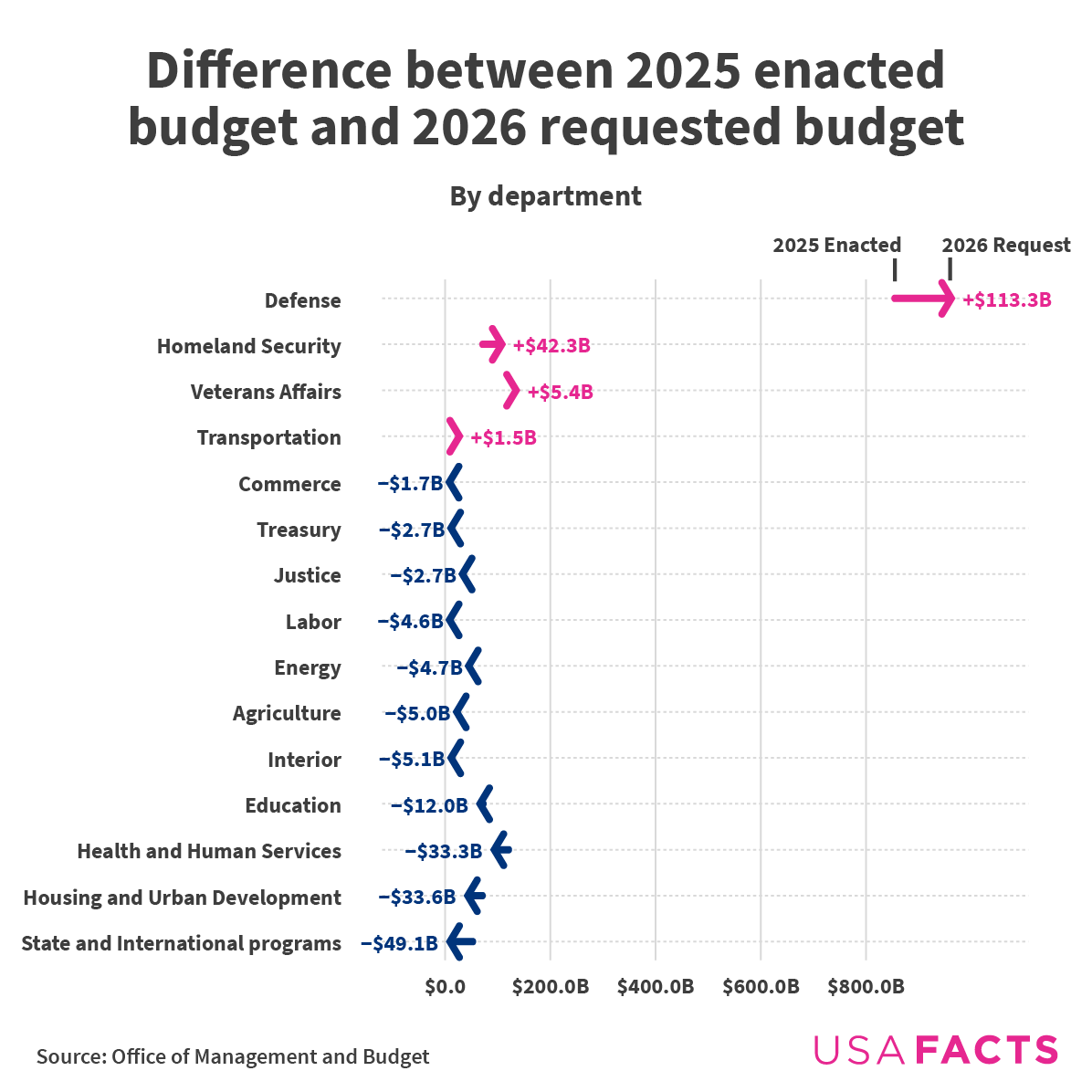
Difference between 2025 enacted budget and 2026 requested budget
  • The proposed 2026 budget would keep base discretionary spending at the same level as 2025, but shifts billions out of some departments and into others. It would move $113.3 billion to the DOD, meaning the department would have 59.6% of all base discretionary spending.  
     
  • The Department of Homeland Security budget would have the largest percentage increase (64.9%) to support immigration enforcement and other administration policies. Funding for FEMA, TSA, and cybersecurity, among other programs, would be reduced.  

  • The State Department and international aid programs would be cut by 83.7%, including reductions in international disaster assistance and global health efforts. 

  • The administration also proposes a 43.6% decrease in program funding for the Department of Housing and Urban Development, reducing it from $77.0 billion to $43.5 billion. This includes a $26.7 billion cut in federal rental assistance programs.
     
  • The Education Department’s discretionary budget would drop 15.3%, from $78.7 billion to $66.7 billion. (You can read USAFacts Founder Steve Ballmer’s open letter to Education Secretary Linda McMahon on LinkedIn.) 

Americans aren’t saving like they used to

Americans saved an average of 4.6% of their disposable income in 2024. The US personal saving rate is a measure of people’s financial health and is one indicator of consumer behavior and economic growth. Rising personal savings can mean people are spending less, which can lead to slower economic growth. Consumer spending accounts for 70% of the US economy.  

Congress is considering legislation to create a Universal Savings Account, an investment vehicle exempt from taxes and withdrawal penalties. The idea is to encourage more Americans to save because they aren’t saving as much as they used to.  
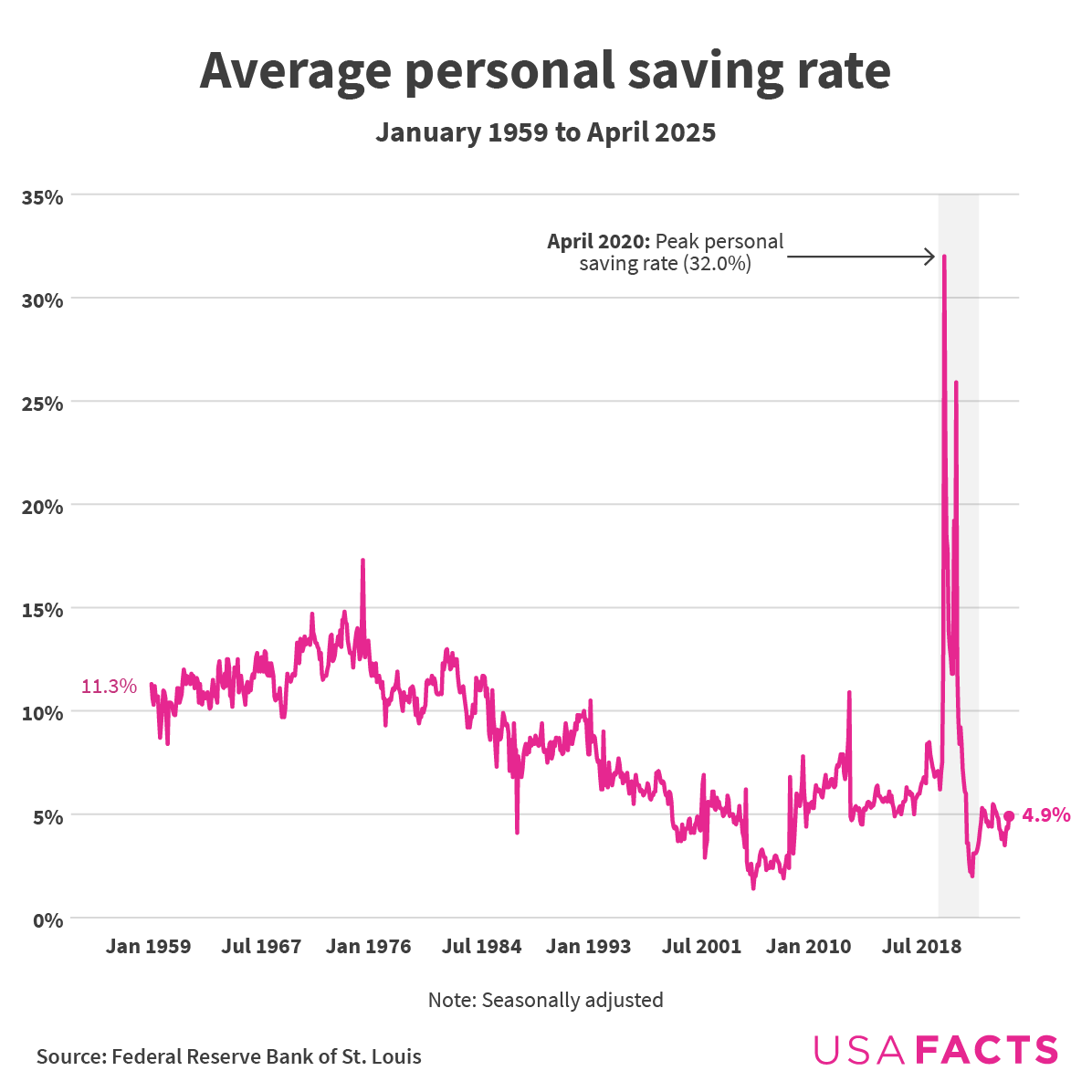
  • The personal saving rate in the 1960s and 1970s averaged 11.7%, peaking at 17.3% in May 1975. It’s gradually declined since then, reaching an all-time low of 1.4% in July 2005. 
Average personal saving rate
  • Personal savings peaked at 32% in April 2020. There are a few reasons for this, including households proactively saving during economic uncertainty. Business closures reduced opportunities for spending, contributing to higher savings.

  • Inflation is another reason for lower savings: food and fuel costs may rise while wages don’t increase at the same rate. This goes for housing, too. Over one-third of all households were cost-burdened in 2023, spending more than 30% of their income on mortgage or rent. 

  • Americans may also be saving in different ways. The share of American assets held in stocks rose from 15.2% to 20% from 2019 to 2022. 

Data behind the news

The Trump administration has resumed sending some weapons to Ukraine. Remember last week when we said more data on government assistance to foreign countries was coming soon? It’s here! Dive into aid sent to Ukraine and 175 other countries.  

As of July 8, the US has counted 1,288 cases of measles. This is the highest yearly case count since the nation declared measles eliminated in 2000. We have a new page tracking these cases across states.  
 
Thousands of Philadelphia city workers had been on strike for over a week, resulting in residential trash piling up. They reached a deal with the city last Wednesday.  

President Trump approved a major disaster declaration for Texas on July 6, making FEMA funding available to people affected by the devastating floods.  

Can you ace our weekly fact quiz

One last fact

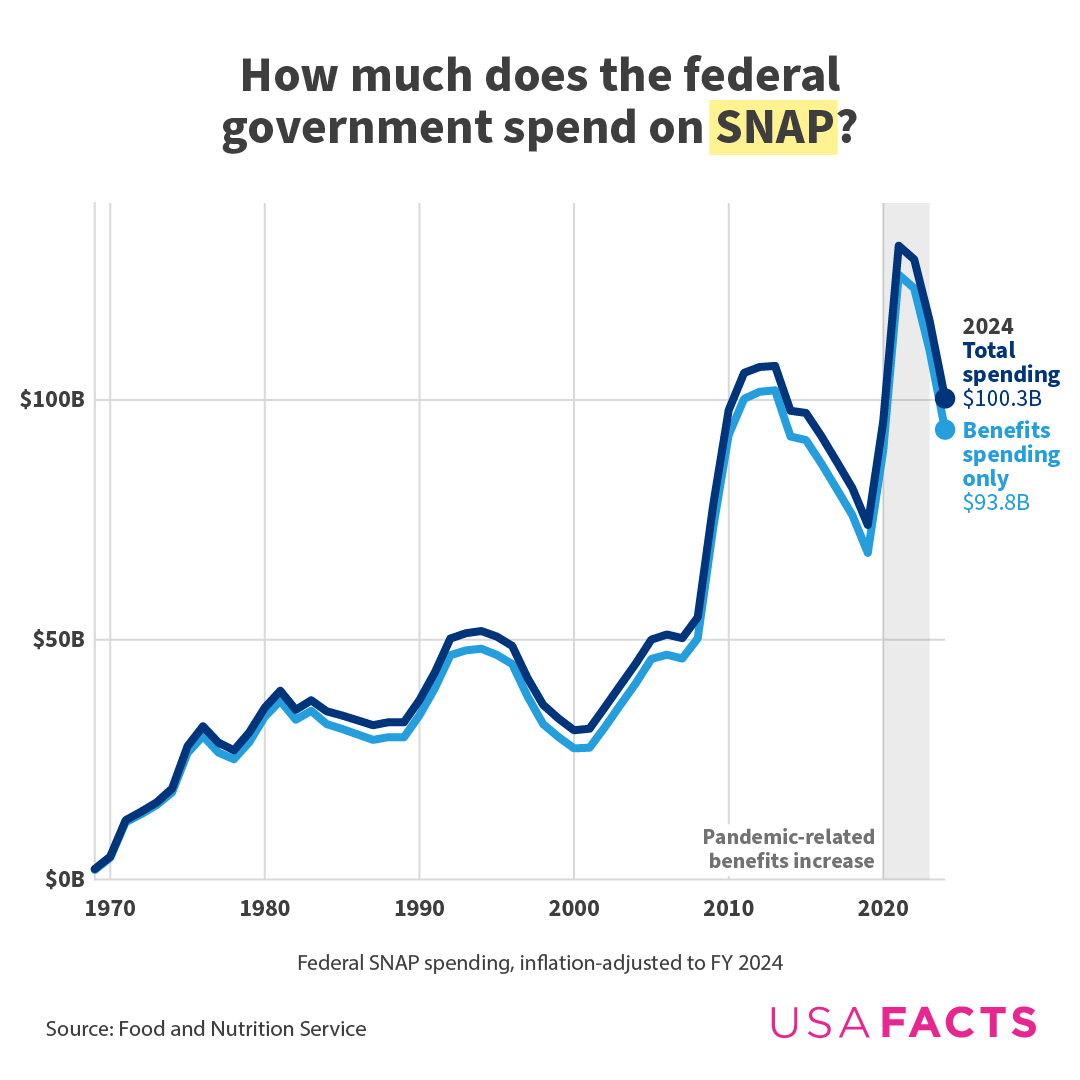
How much does the federal government spend on SNAP?
In 2024, the federal government spent $100.3 billion on the Supplemental Nutrition Assistance Program (SNAP) — about 1.5% of total federal spending. The average monthly benefit in 2024 was $188 per person, down from the 2021 peak of $253. 

Sunday, February 16, 2020

Notations From the Grid (Week-End Edition): Out & About....

Please Enjoy:

The February 13, 2020 digital issue of AUSA Extra is now available.

To view, click the cover image or copy and paste the following link into your browser:
https://info.ausa.org/e/784783/02-13-2020-/cxwx/84715695?h=P-PiyyOj6S13Q3YgvV6rAncApA2YWJ3h30Gi89sdpT8
Click this icon to download a .pdf copy of the digital magazine. File may be large in size.

Friday, January 17, 2020

Notations From the Grid (Friday Special Edition): #RandomThoughts

Please enjoy these uplifting educational depictions of our World as Phase I of the  US-China Trade Agreement was signed and as the Impeachment Trial of the President began courtesy the Financial Times and The Economist of London:


Wednesday, August 14, 2019

Notations From the Grid (Special Edition): On Stepping Up Journalists' Safety

Our team has made an editorial decision to feature this newsflash courtesy of the team at the Committee to Protect Journalists which will be featured on all our key Virtual Properties for the Week :

Stepping up journalists’ digital safety know-how
CPJ’s Emergencies Response Team released in July an updated Digital Safety Kit to provide journalists with the latest information on how best to protect themselves and their sources through secured digital accounts, devices, and online communications. The kit also provides practical advice to help journalists navigate digital threats like phishing attacks and specific concerns related to crossing borders, when authorities may seek to inspect devices.
Available in English, FrenchSpanish, and Russian, journalists and media organizations may freely use and share the text under the terms of our Creative Commons license. News of the kit was well-received on social media, garnering hundreds of likes and retweets, and was distributed to partners, who welcomed the resource and shared it through their networks. 
Separately, CPJ went to Cúcuta, Colombia, in July with a partner organization to educate Venezuelan journalists on digital safety. Journalists working in Venezuela have been facing rampant harassment both online and offline, and CPJ has been advising individual journalists and media outlets on the ground on how to strengthen digital security practices. The three-day meeting in Cúcuta, a safe location that is relatively easy for Venezualan journalists to reach, was designed to build expertise in a small group of journalists that they can then share with colleagues inside Venezuela.